News from Institutes, Associations and Industry

The EWPA 74th Annual Congress 2026 was held in Bath, United Kingdom during September 9-11, 2026.
The following documents from the EWPA 2026 congress are available as PDFs:
EWPA 2026 Agenda
EWPA 2026 Programme
EWPA 2026 Participants
We anticipate providing a summary of the outcomes from the EWPA 2026 Congress in due course.
---------------------------------------------------------------------------------------------------


SMART-LIVING - Slovenia
The Biotechnical Faculty of the University of Ljubljana has secured nearly €5 million in funding for an ambitious new research and innovation initiative focused on the buildings of the future. The project, titled SMART-LIVING, is supported by the Slovenian Research and Innovation Agency (ARIS) and positions the faculty as the lead partner in a diverse consortium of academic and industrial collaborators.
SMART-LIVING addresses one of the most pressing challenges of modern society: the environmental and social impact of buildings. Across the European Union, buildings account for around 43% of total energy consumption and approximately 36% of greenhouse gas emissions. The project aims to tackle these challenges by developing advanced solutions for sustainable, zero-emission, and energy-efficient buildings that also prioritize human health, safety, and well-being.
At the core of the initiative is an innovative “quadruple zero” concept—zero emissions, zero energy consumption, zero health and safety risks, and zero stress for occupants. To achieve this, researchers will combine cutting-edge biomaterials, digital technologies, and artificial intelligence with new design and construction approaches.
The program brings together leading partners, including multiple faculties of the University of Ljubljana, the University of Maribor, research institutes, and several prominent companies. This strong collaboration between science and industry will enable the transition from fundamental research to real-world applications, covering technology readiness levels from early-stage research to advanced prototypes.
A key outcome of the project will be the construction of a full-scale demonstration building in Slovenia, showcasing innovative solutions in practice. By bridging research and industry, SMART-LIVING represents a significant step toward climate-neutral, healthy, and user-centered living environments, while strengthening Slovenia’s role in advancing sustainable construction and smart building technologies.
--------------------------------------------------------------------------------------------------------------

New research object in the Hamburg Arboretum
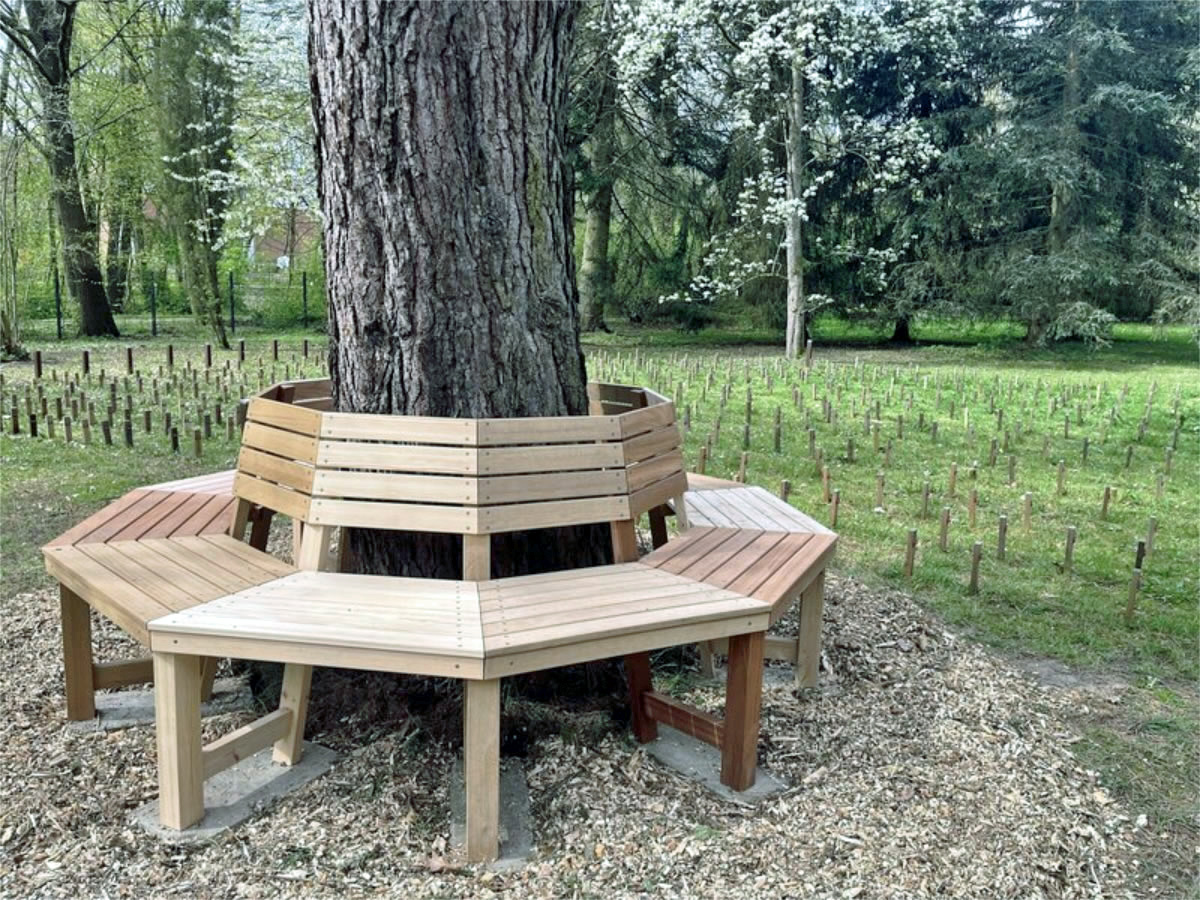
Elegant garden furniture serves research and invites you to linger.
The scientific arboretum of the Thünen Institute for Wood Research holds many surprises. Besides a total of more than 1.000 tree and shrub species spread across approximately 9 hectares, there are also experimental plots where the biological durability of wood is investigated, tested, and classified. In the immediate vicinity of the so-called "graveyard test“, a new research object has been added, which also invites visitors to linger or rest. A bench encircles an impressive black pine (Pinus nigra). The bench is made of ten different wood species, all of which are also exhibited in the institute's test fields as part of various research projects. In addition to standardized property testing, the aging of these wood species can now also be observed on a real piece of wooden furniture in the outdoor area. These are Scots pine (Pinus sylvestris), Western red cedar (Thuja plicata), Japanese larch (Larix kaempferi), Lebanon cedar (Cedrus libani), English oak (Quercus robur), black locust (Robinia pseudoacacia), afzelia (Afzelia spp.), itauba (Mezilaurus itauba), sipo (Entandophragma utile) und iroko (Milicia excelsa). (Click thumbnail to view enlarged)
--------------------------------------------------------------------------------------------------------------