
CRF 2025 Project Approved
A global comparison of field test methods to determine the above-ground durability of wood (DURAWORLD)
Background:
For a reliable prediction of the performance and expected service life of wooden components, robust data on the durability of wood is required, determined under conditions that are as realistic as possible. Unfortunately, there is a perpetual dilemma in durability testing, as tests that are as close to reality as possible are only possible in the field, but these usually take a long time and incur high costs. It is therefore all the more important to have well-functioning methods for field testing, especially for above-ground scenarios, since they usually require even longer test durations due to non-permanent wetting and thus a lower decay hazard.
Worldwide, around 100 methods were described for above-ground durability testing, but only very few have been standardised. These few were basically developed for determining the relative protective effectiveness of a wood preservative (i.e. efficacy testing), but not necessarily meant for testing the durability of wood species or wood-based materials.
In Europe, there are currently two draft standards for methods that are intended to replace the much-criticized lap-joint method or at least supplement the portfolio of test methods: (1) the sandwich-test, and (2) the bundle-test (Figure 1). Round Robin tests have recently been initiated for each of these methods, but a comprehensive and comparative field trial is still lacking. In particular, a comparison between the two methods and the lap-joint method is needed and should be conducted at climatically very different locations. This is the only way to reliably determine the moisture load and the resulting risk of decay posed by the three methods.
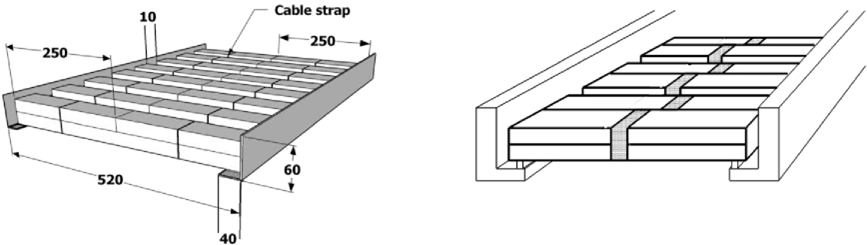
Figure 1. Draft standards for above-ground durability testing. Left: Bundle-test. Right: Sandwich-test.
Research fellows and IRGWP members from 11 countries teamed up to establish a long-term comparative field trial at climatically different locations representing 11 countries on 6 continents. The following research objectives will be addressed:
Objectives:
· Comparison of methods for above-ground durability testing (i.e. sandwich, bundle, and lap-joint method)
· Comparison of assessment criteria (according to different standards, e.g. CEN, ASTM, AWPA)
· Establish assessment criteria that can be used for durability classification and decay modelling
· Input to standardisation
Work plan:
The Thünen Institute of Wood Research (TI) is the applicant and coordinator of DURAWORLD and will be responsible for sourcing wood, producing test specimens, and shipping them to the individual research partners. Exposure and regular assessment of the specimens will be the responsibility of the individual partners. Specimens from six wood species will be exposed at all test sites. If desired, additional wood species or wood-based materials of regional interest may be included by the respective partners at their individual test sites. The details of the experimental set-up are given in the following:
Experimental set up:
Above-ground test methods (3)
(1) Lap-joint test
(2) Bundle test
(3) Sandwich test
Test materials (6)
To be exposed at all sites (n = 10):
(1) Scots pine sapwood
(2) European beech
(3) Norway spruce
(4) Scots pine heartwood
(5) Black locust
(6) European larch
Additional species/materials of regional importance for the respective partners could be included at national test sites.
Test sites (responsible partner)
(1) Bergen (Norway) – NIBIO/NTI
(2) Hamburg (Germany) – Thunen
(3) Borås (Sweden) – RISE
(4) Ljubljana (Slovenia) – University of Ljubljana
(5) Vancouver (Canada) – FPInnovations
(6) Hilo (USA) – MTU
(7) Brisbane (Australia) – QDPI
(8) Kourou (French Guyana) – CIRAD
(9) Cap Estérias (Gaboon) – CIRAD
(10) Jeronimo Monteiro (Brazil) – Federal University of Espírito Santo
(11) Tsukuba FFPRI (Japan) – FFPRI
The total number of specimens will be 1,980. Any additional specimens will be provided by the respective partners.
Assessment:
The specimens will be exposed on test racks (0.4 or 1.0 m high) and assessed for signs of fungal decay (and termite attack) every 6 months. The minimum duration of the test is five years or until all specimens have failed.
The assessment will be carried out according to the respective standard or draft standard. In addition, the European and the American assessment scheme will be applied and compared on the lap-joint specimens. For the sake of comparative analysis and as an input for decay and service life modelling decay depth and remaining cross section will be determined for all specimens as well.
Communication Plan
The data obtained from the field tests will be (1) shared among the partners, (2) uploaded on the IRGWP Durability Database (DDB), and (3) used for the publication and presentation of the study results as follows:
Presentations at IRGWP conferences:
· 2027: IRG58 (Venice): IRG Scientific paper and Oral presentation of the DURAWORLD project
· 2029: IRG60: IRG Scientific paper and Oral presentation of preliminary results (Focus on less-durable reference species and comparison of assessment criteria)
· 2032: IRG63: IRG Scientific paper and Oral presentation of the final results after 5 years
Publication of data:
· 2029: Upload of preliminary data sheets on the IRGWP DDB
· 2032: Upload of final data sheets on the IRGWP DDB
· 2029: Report to CEN/TC 38 WG 25 – Preliminary results
· 2032: Report to CEN/TC 38 WG 25 – Final results
Peer-review journal articles:
· Article 1 – Focus: Comparison of test methods, Suitability for standardised testing
· Article 2 – Focus: Impact variables on test results and durability classification (e.g. climate, assessment criteria, reference species)
Further conference contributions:
· 2027: WSE (Annual Meeting of the Northern European Network on Wood Science and Engineering) – Poster presentation
· 2031: 19th DBMC (Durability of Building Materials and Components) – Oral presentation
Further publications and presentations may be added if the results obtained allow this.