
Rod Eaton

--------------------------------------------------------------------------------
Click on thumbnails and links for enlarged or expanded content.
Remembrances and Bio by Pam Eaton
Rod was born in Salford, Lancashire during April 1944, and died on August 24, 2025 at 81 years old. He attended Lancaster Road Primary and Junior School and then Salford Grammar School before going to The University of Sheffield. He graduated in 1965 with a B.Sc (Hons) in Botany. He subsequently went to what is now known as The University of Portsmouth School of Biological Sciences as a Research Assistant. His PhD on the deterioration of wood in cooling towers followed and in 1996 he was made Principal Lecturer and Associate Professor (previously titled Reader). He was Deputy Head of Biological Sciences and Head of Marine Biology in his latter years. He retired in 2005.
We mustn’t forget the book he wrote with Mike Hale - Wood. Decay, Pests and Protection, published in 1993. Dr Lone Ross, the incoming President of the IRG in 2016, Lisbon, kept a copy of it on her desk! Rod, Tony Bravery and Dave Dickinson (with their spouses) attended that meeting - their last.
Tomas Nilsson collaborated with Rod on the Vasa Project in Sweden. A prelude to the preservation of the Mary Rose in Portsmouth.
It’s so good to know just what esteem he was held in. I’m quite overwhelmed. He never bragged and I’m only now really appreciating his many talents as a teacher, dad and husband.
Rod’s interests were rugby, football, cricket, travelling and gardening. His team, Manchester United was, sadly, out of sorts in recent years! He was also very occupied after his retirement with collecting some wonderful antiques. He assembled an interesting Family History and a vast collection of British and Australian stamps.
We were both only children so our family is small. Our girls, Julia and Tracey are married to wonderful husbands and we have three delightful grandchildren. We miss him dreadfully.


--------------------------------------------------------------------------------
IRG
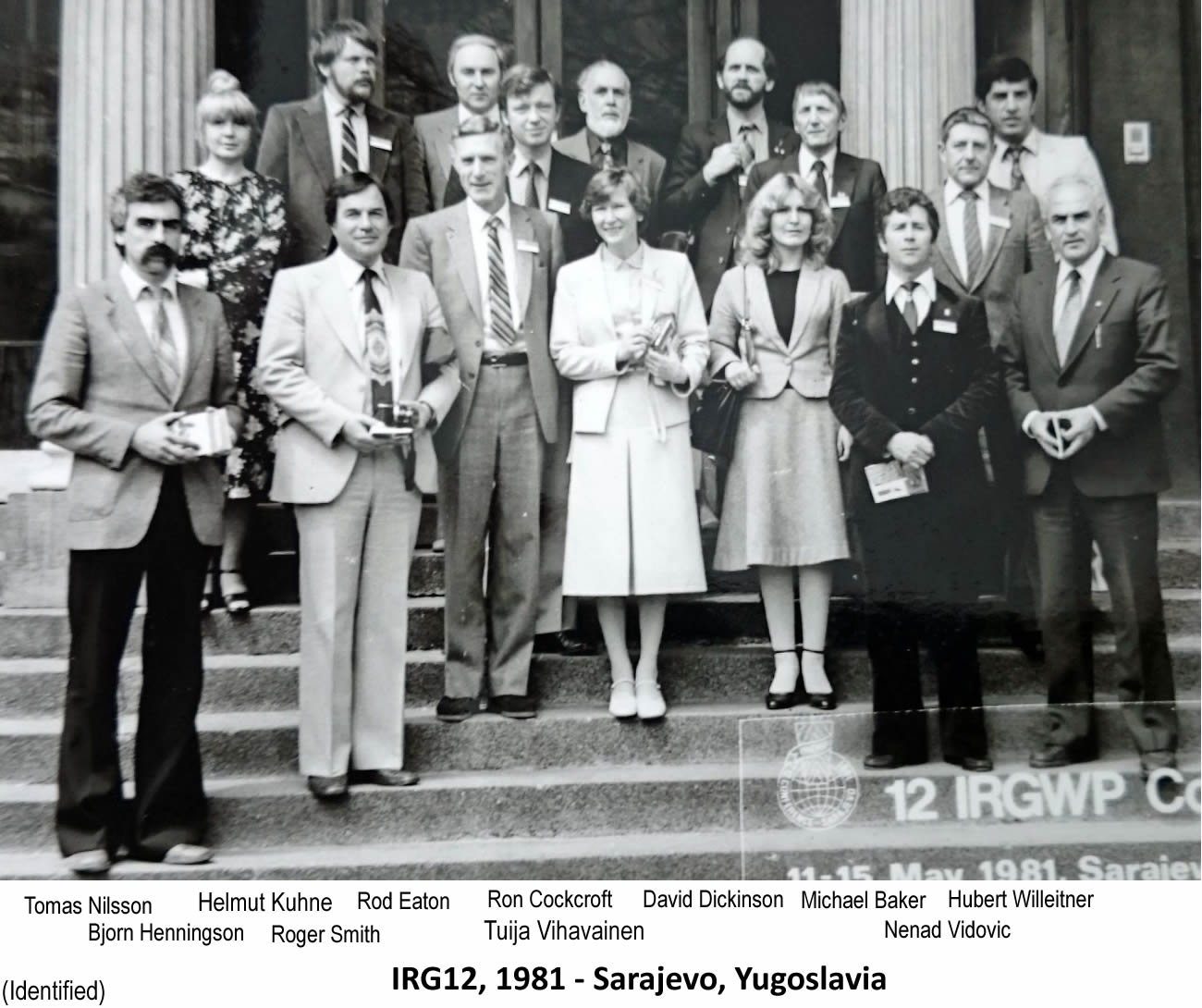
Rod attended IRG1 the inaugural IRG meeting held in 1969, one of only 46 attendees. Rod went on to attend a total of 31 IRG meetings, a remarkable record that few among us can even come close to, Rod's last meeting being IRG47 in Portugal in 2016.
Rod was an active participant in every IRG meeting he attended, bringing knowledge and insight, as well as charm, humor and friendliness wherever he went. Among Rod's many attributes he may well most be remembered as the supervisor and mentor of many young scientists who had the privilege of benefiting from his knowledge and learning.


--------------------------------------------------------------------------------
Tributes
Neil Strong and Craig Brown
We arrived in Portsmouth in late 1994 for our interviews, brimming (we like to think) with scientific potential. We were fortunate to be offered PhD positions and, in February 1995, began an academic journey into the world of wood preservation under the expert supervision of Dr. R.A. Eaton. Rod’s belief in us was such that he secured funding to transform the old city morgue into laboratory and office space. Over the next four years, this unlikely hub of discovery hosted countless marine and terrestrial experiments—its aromas drifting somewhere between sawmill and fish market (with the occasional smoky note, though perhaps best left unspoken…).
Through it all, Rod was an exceptional supervisor and mentor. His guidance shaped our development as researchers, from experimental design to data analysis, writing, and even supervision of undergraduate students. He championed our participation in conferences around the world, including the unforgettable IRG meetings in Whistler (1997) and Maastricht (1998). These experiences laid the foundation for our careers in industry and academia, and through them, many others have indirectly benefitted from Rod’s teaching and mentorship.
Of course, wood preservation was only part of our education in those years. Many of our fondest memories with Rod revolve around camaraderie, laughter, and more than a few shared drinks - stories that will no doubt resurface when we gather again. Suffice to say, the final word should be Rod's telling of an experience of his at a conference in China when, following a few whiskies, one of his hosts was heard to say "Professor Eaton has lost the use of his legs..."
To us, Rod was “Big Bird” - a larger-than-life presence, kind, caring, and endlessly supportive. We, in turn, were “Chippy and Nibbs,” as nicknamed by our Portsmouth peers after the Minton family carpenters from the kids show “Trumpton”. Together, we built not only a body of research but also fond memories we will continue to treasure.
Rod’s guidance, generosity, and unwavering support have left an enduring mark on our lives and careers. We are deeply grateful for his mentorship and friendship. To Pam and the family, we extend our sincere condolences and our heartfelt wishes. - Dr Neil Strong and Dr Craig Brown


Michael Powell
I had the privilege of working with Dr. Rod Eaton at Portsmouth Polytechnic (later the University of Portsmouth) from 1990 to 1993 as his Research Assistant. In that time, I came to know not only an exceptional mentor but also a generous and quick-witted colleague. With Dr. Joan Webber of the UK Forestry Commission, our work focused on sapstain fungi in freshly felled and water-stored timbers. His guidance and support were constant—he was an excellent educator, gave freely of his time, encouraged independent thought, and lightened challenges with characteristic dry humour. He also liked a pint and enjoyed the cricket. We were lucky enough to overlook Hampshire CC’s second ground and, if memory serves, also fielded a pretty handy Biology Dept team.
Rod’s passion for wood science was infectious and enduring. His research spanned the breadth of wood science and its environmental interactions from biodeterioration to wood protection. His extensive publication record and long history of participation within the International Research Group on Wood Protection (IRG-WP) reflects his expertise and lasting influence in the international wood protection community.
He profoundly shaped my career and my life. Rod introduced me to the IRG-WP, involving me in its 1992 Harrogate meeting and supporting my Ron Cockcroft Award to attend IRG25 in Bali (1994). His advice/support to visit colleagues in New Zealand and Queensland proved life-changing, ultimately influencing/allowing me to make Australia my home.
I will remember Rod as a fine mentor, diligent researcher and accomplished educator who profoundly shaped wood science research and the lives of those fortunate to work/study with him. His legacy endures through his research and the many students, like me, that he inspired and influenced in the most positive of ways.


Matt Guille
Professor of Developmental Genetics at the University
I actually shared an office with Rod when I first arrived in December 1995 and to my recollection, he was already a Reader and Deputy Head of School then. It was so useful to share with someone whose experience and knowledge of teaching undergraduates was really extensive and deep, he also showed a great deal of patience answering my many questions and definitely made a major contribution to enhancing my teaching skills. Rod was a very positive person and genuinely fun to share with, it made integrating into the school very easy.
Eric May
We wanted you to know that we are thinking of you all as you come to terms with your loss. For his friends and colleagues, Rod was a dependable and reliable source of fun, wisdom and knowledge. I shared a room with Rod for 21 years and he was a rock for me throughout that time. He used to joke that, during the term, we spent more hours together that he did with his family! I appreciated him being there as a mentor in my early days, as a sounding board generally and as a friend when times were tough. He was an excellent teacher and a meticulous, thorough researcher, respected by his peers all over the world, and his research students. We shared many a laugh over the years, in the department, and occasionally, abroad. One particular trip to Hong Kong with him, when he slept for almost 24 hours, was legendary! Whe he left for retirement, he left a big gap. Subsequently, the time spent playing golf or chewing the cud over a pint was always something to look forward to. We will miss him and remember the good times we were able to share with him.
Tony Bravery
I met Rod for the first time in late 1965 within a few weeks of being appointed a Scientific Officer in the Mycology Section of the UK Government’s then Forest Products Research Laboratory (FPRL) in Princes Risborough, led by John Savory. John was a close friend of Dr Gareth Jones, Marine Microbiologist at what was then Portsmouth Polytechnic, later to be come the University of Portsmouth. Rod had just begun his PhD studies there with Gareth. As John and Gareth were both just starting ‘new boys’ in the world of ‘Wood microbiology’, John invited Gareth’s ‘new boy’ to spend a few days working at FPRL to be introduced to the people (in particular me!) and techniques in the Mycology Section there.
So for me began a 60-year friendship that saw Rod and I share professional as well as personal associations that took us from joint laboratory experiences, shared roles in Portsmouth’s MSc course in Materials Biodeterioration (I as an External Examiner), conference participations (especially within IRG) and personal visits with our respective wives. This friendship continued throughout our retirement time together, including a few days every year together at one another’s homes. I especially remember enjoying time together in the English Lake District (with Dave and Pat Dickinson on that occasion), sailing on Rod’s boat in and around Portsmouth and Chichester, watching cricket at Arundel and sharing ideas and experiences about our gardens – and about Manchester United!
Whenever with Rod one could expect a lot of laughs, some serious exchanges putting the world to rights, and a few glasses of good beer and wine! Rod was passionate in all his interests and pastimes and very loyal to his friends, students and colleagues; jovial yet intense in equal measure. He is going to be much missed – but has left his mark. - 4 September 2025


Simon Cragg
I am glad to have the opportunity to reflect on and record my appreciation of Rod Eaton, as a mentor, collaborator, scientist and friend.
My initial experience of him was as the originator of consignments of meticulously prepared replicate samples of CCA and CCB treated timbers. These were for the IRG/COIPM International Marine Test and I was tasked with the Papua New Guinea deployments. Rod led the IRG Marine group to which all data from this project were sent and I got the chance to meet him at the meetings of the Marine Group of IRG, which he coordinated. I was impressed with, and felt I learned from, his ability to bring together work from multiple sites around the globe and his light-touch but effective marshalling of this specialist group. The work continued from inception in 1976 though till at least 1986. At that point, Rod set up a fellowship for me to enable me to return to the UK. This presented a crucial career step that would not have been available without his reputation, contacts and ability to persuade the funders. He helped me very generously with re-acclimatising myself to life in the UK. Notably, he and Pam his wife took me into their home while I found somewhere to live. His wise and steady mentorship helped me to progress to a tenured academic position.
Rod set up a trial of polyurethane coated wood at fourteen sites (covering Africa, the USA, South America, Europe, New Zealand and Australia). The ten-year report appeared at IRG in 1996. Rod and his student Craig Brown contributed very substantially to the multinational PINTO project on effects of CCA treated wood in the marine environment. Another EU-funded project – BACPOLES - followed, building on Rod’s experience in microbial colonisation of saturated wood. His research was remarkably diverse, but focused within the field of microbial colonisation of wood, covering degradation of wood in cooling towers, sapstain colonisation aided by microarthropods, marine white rot fungi, archaeological wood and water storage of wood. He and another student, Mike Hale, revealed microscopic and ultrastructural features of soft rot decay. Rod and Mike went on to produce a much-valued key text on biodeterioration of wood, in which his ability as a teacher and communicator shines through.
Alongside his research, he was very committed to his other academic activities in course development, lecturing and administration. In his role of Deputy Head of Department, he was hard-working consistent and fair. Perhaps most tellingly, for the other members of staff, was that this effort was not obvious as Rod was self-effacing. As well as the BSc programme, the MSc Biodeterioration of Materials course was guided by him. It had a National reputation and generated numerous graduates who went on to successful careers in the field.
It was a pleasure to work with and be guided by Rod, who was an excellent mentor. It was also fun to share a cricket field with him in our interdepartmental evening matches and our University Academics team. Rod’s warm and generous personality shone through in events after matches, work and conference days. Thank you Rod!


Click on thumbnails for enlarged or expanded content.
This Tribute was written for inclusion with the September 2025 IRG Newsletter.
Acknowledgements
It is with much gratitude that the IRG acknowledges the contributions of the following contributors to the Tribute to Rod Eaton:
Neil Strong (PhD)
Biodiversity strategy manager
Network Rail
Milton Keynes, England, United Kingdom
Craig J. Brown (PhD)
Associate Professor
Department of Oceanography
Seascape Ecology and Mapping (SEAM) Lab
Dalhousie University
Halifax, Nova Scotia, Canada
Michael Powell
Principal Consultant/Director
Biotica EC Pty Ltd
Sippy Downs, Queensland, Australia
Anthony (Tony) Bravery (PhD)
Retired
Building Research Establishment, Leader
Princes Risborough, England, United Kingdom
Tony's IRG Bio
Matt Guille (PhD)
Professor of Developmental Genetics
University of Portsmouth
Portsmouth, England, United Kingdom
Eric May (PhD)
Biofilms Research
School of Biological Sciences
University of Portsmouth
Portsmouth, England, United Kingdom
Simon Cragg (PhD)
Emeritus Professor
Marine Sciences
University of Portsmouth
Portsmouth, England, United Kingdom